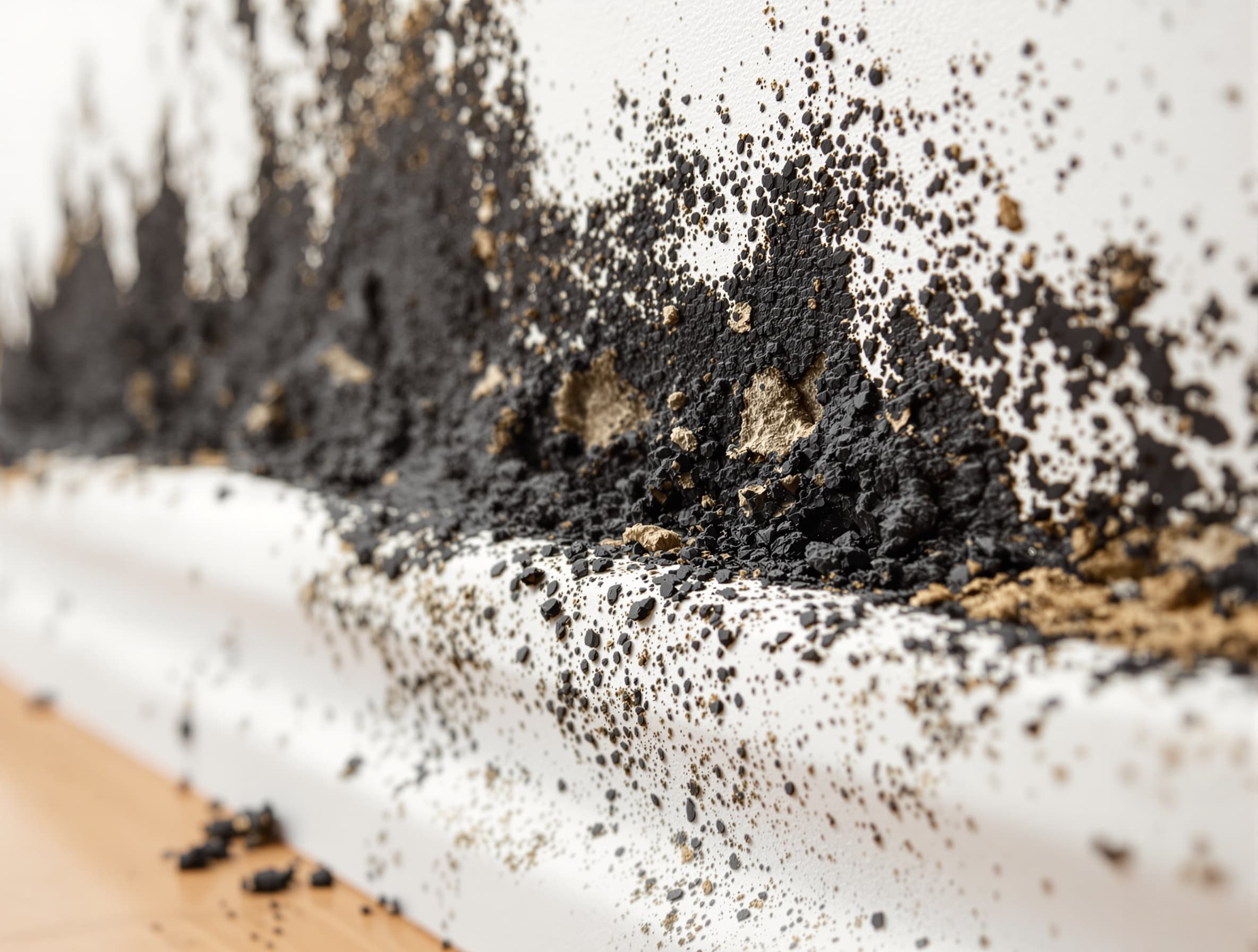
Black mold removal in Suffolk County is not the same job as black mold removal anywhere else in New York. The county's geography — a 912-square-mile peninsula bordered by the Long Island Sound to the north and the Atlantic Ocean and Great South Bay to the south — creates persistent moisture conditions that make mold remediation both more common and more complicated here than in Nassau County or the five boroughs.
This guide covers what Suffolk County homeowners specifically need to know: why local basements are so prone to black mold, the NY Article 32 licensing requirements that govern every job over 10 square feet, what professional remediation actually costs here, and the difference between what you can do yourself versus what the law requires you to hire out.
Why Suffolk County Basements Grow Black Mold
Three structural factors make Suffolk County one of the highest-risk mold counties on Long Island:
High water table across South Shore towns
Towns along the Great South Bay — Bay Shore, West Islip, Babylon, Lindenhurst, Islip, Patchogue, Sayville — sit on a water table that can be as shallow as 2 to 4 feet below grade. Hydrostatic pressure pushes groundwater against foundation walls year-round. Even homes with no flooding history accumulate moisture in concrete block walls, floor slab edges, and sub-slab aggregate. That moisture migrates into finished basement framing and drywall, creating the sustained wet environment that Stachybotrys chartarum — true black mold — requires.
Post-hurricane flood zones and Sandy legacy
FEMA flood zones cover large portions of South Shore Suffolk. Superstorm Sandy's 2012 storm surge affected hundreds of thousands of properties across Babylon, Islip, and Brookhaven towns. While many were remediated at the time, incomplete drying protocols and rebuild timelines that were too compressed left residual mold behind finished surfaces. We regularly open walls in Bay Shore, Amityville, and West Islip today and find active Stachybotrys colonies that trace directly to 2012 water intrusion — behind 2013 drywall that looked pristine from the outside.
Older housing stock with no modern vapor barriers
The bulk of Suffolk's residential inventory was built between 1950 and 1975 — William Levitt's expansion into Levittown, Commack, Hauppauge, and the Route 25A corridor communities. These homes were built without modern vapor barriers, with poured concrete or concrete block foundations that absorb ground moisture freely, and with basement conversions added decades later on top of already-damp materials. The combination of original 1950s moisture pathways and 1980s or 1990s basement finishes is the most common mold scenario we see across central Suffolk.
NY Article 32: The Licensing Law That Governs Every Suffolk County Mold Job
New York Labor Law Article 32, in effect since January 1, 2015, created a three-tier licensing system for mold work on any project affecting more than 10 square feet. Before hiring anyone for black mold removal in Suffolk County, you need to understand this law — because unlicensed mold work is both illegal and potentially voidable for insurance purposes.
- Mold Assessor (MA license) — the inspector who identifies mold, measures the affected area, documents moisture sources, and writes the remediation scope. Cannot perform the remediation on the same property.
- Mold Remediation Contractor (MR license) — executes the cleanup per the assessor's written scope. Cannot write the assessment for the same job.
- Mold Remediation Worker (MW license) — technicians working under a licensed MR contractor.
The most important rule: on any project over 10 square feet, the same entity cannot both assess and remediate. This conflict-of-interest wall was specifically written into Article 32 to prevent the inflated scoping that was rampant before 2015, when one company could inspect, find whatever scope generated the largest job, and then perform that remediation with no independent check.
Suffolk County-area NYLMB-licensed assessors can be found through the NY Department of Labor's Mold Program database. When evaluating any Suffolk mold company, ask for their NYLMB license number — MA prefix for assessors, MR prefix for remediators — and verify it on the DOL database before signing anything.
What Black Mold Removal in Suffolk County Actually Costs
Cost ranges for black mold removal in Suffolk County in 2026, based on completed jobs across the county:
- Small contained jobs (under 10 sq ft — a bathroom ceiling patch, small closet wall): $400–$900. This falls below the Article 32 threshold for mandatory assessment, so homeowners can engage a remediator directly.
- Mid-size residential jobs (10–50 sq ft — basement wall section, crawl space perimeter, single room): $1,200–$3,500. Mandatory Article 32 assessment required before remediation begins. Assessment adds $250–$500 to the overall cost.
- Large jobs (50–200 sq ft — full finished basement, extensive attic): $3,000–$8,000. Often involves full demo of affected finishes, structural drying, and post-remediation verification clearance testing.
- Post-flood Category 3 (sewage or storm surge intrusion) or whole-house Stachybotrys: $5,000–$15,000+. IICRC S520 Category 3 protocol with containment, full PPE, bag-out disposal, and air monitoring.
Suffolk County jobs run slightly lower than Nassau on average — Suffolk's older but lower-value housing stock means contractor overhead is lower, and competition among licensed mold companies is higher in central Suffolk than in the North Shore Nassau premium market. South Shore Suffolk jobs that involve post-flood protocol or Category 3 water are the exception — those are priced comparably to or above Nassau because of the specialized equipment and disposal requirements.
IICRC S520 Protocol: What Proper Remediation Looks Like
The IICRC S520 Standard for Professional Mold Remediation defines the technical requirements that every legitimate black mold removal project in Suffolk County should follow. At a minimum, a proper S520-compliant remediation includes:
- Containment: plastic sheeting barriers with zipped entry points isolating the work area from the rest of the home.
- Negative air: HEPA-filtered air filtration devices (AFDs) creating negative air pressure inside containment so airborne spores cannot escape to clean areas.
- PPE: Tyvek suits, P100 respirators, gloves, and eye protection for all workers inside containment.
- Demo: Removal of all non-salvageable materials (drywall, insulation, carpet) with double-bagged HEPA-vacuum bag-out.
- Treatment: Antimicrobial application to affected framing, followed by HEPA sanding or media blasting of Stachybotrys colonies on wood.
- Drying: Structural drying of all remaining materials to below-12% moisture content before containment comes down.
- PRV: Post-remediation verification — independent air sampling and visual inspection by a licensed assessor confirming clearance before the space is released for rebuild.
What Homeowners Can Do vs. What Requires a Licensed Contractor
NY Article 32 is specific: any mold project affecting more than 10 square feet of surface area requires a licensed mold assessor's written scope before remediation begins, and a licensed MR contractor to perform the work. Below 10 square feet, a homeowner can DIY. But the 10-square-foot threshold is smaller than most people think — it's roughly the area of a standard ceiling tile.
For genuinely small mold patches — a bathroom ceiling spot after a hot shower, a window sill with surface mildew — homeowners can clean with an EPA-registered antimicrobial product and a stiff brush. Fix the moisture source (the bath fan, the window seal) or the problem recurs in 6 weeks regardless of what you sprayed.
For anything in a basement, crawl space, or enclosed wall cavity, the prudent call is a licensed assessor first. You cannot visually determine whether a small surface patch is the full extent of the colony or the tip of something much larger in the wall cavity behind it. The assessment is the only way to know. And in Suffolk County, where the high water table and Sandy legacy mean mold is often more extensive than it looks, that inspection investment consistently saves homeowners from over-paying for incomplete remediation.
Need help with your specific situation?
We do free on-site assessments across Long Island.
NYLMB-licensed, IICRC-certified, insurance-experienced. Call (631) 625-8807 or request an estimate online.