When homeowners in Suffolk County call us about "black mold," they are usually looking at something dark on a wall or ceiling and assuming the worst. The reality is more nuanced — and knowing the difference matters both for your health decisions and your wallet.
What Black Mold Actually Is (and What It Usually Isn't)
Stachybotrys chartarum — the mold most people mean when they say "black mold" — is one of the least common molds we identify on Long Island. It requires sustained wet conditions (sustained moisture above 70% for weeks or months) and grows on cellulose-rich materials like drywall paper and ceiling tiles. Most of the dark or greenish-black growth we find in Suffolk County homes turns out to be Cladosporium or Aspergillus/Penicillium — both common, both worth remediating, but neither the acute-toxin headline species that true Stachybotrys is.
This clarification does not mean you should relax. Any indoor mold colony large enough to be visible is large enough to affect air quality and warrant professional attention. The species identification matters for documentation, insurance claims, and health guidance — but it does not change the core recommendation: find the moisture source, contain it, and remove the mold professionally.
Why Suffolk County Homes Are Particularly Vulnerable
Suffolk County's geography creates baseline conditions that put its housing stock at higher mold risk than most of New York:
- South Shore humidity: The Great South Bay and Atlantic coastline keep summer relative humidity consistently above 70% across Babylon, Islip, Brookhaven, and surrounding towns. Basement walls and crawl spaces absorb ambient moisture even without any leak.
- Older ranch home ventilation: The dominant 1950s–1970s ranch housing stock was designed before modern whole-house ventilation standards. Finished basements added in the 1980s sealed off airflow, creating the stagnant, humid conditions that mold requires.
- Post-Superstorm Sandy legacy: Sandy's 2012 storm surge affected hundreds of thousands of properties across South Shore Suffolk. Incomplete original remediation, compressed rebuild timelines, and subsequent flooding have left lingering moisture in walls and subfloors that continues to seed mold today.
- High water table on the South Shore: Towns like Bay Shore, West Islip, and Lindenhurst sit on water tables as shallow as 2–4 feet below grade. Hydrostatic pressure pushes moisture against foundation walls year-round.
The Black Mold Removal Process
A proper Suffolk County mold remediation job follows the IICRC S520 protocol. Here is what each stage looks like:
1. Inspection and assessment
A NYLMB-licensed mold assessor visits the property, uses a moisture meter and thermal camera to map water-damaged areas, identifies visible mold, and writes a remediation scope. For any job over 10 square feet, NY Article 32 requires this step — and requires that the assessor be a different company from the remediator.
2. Containment
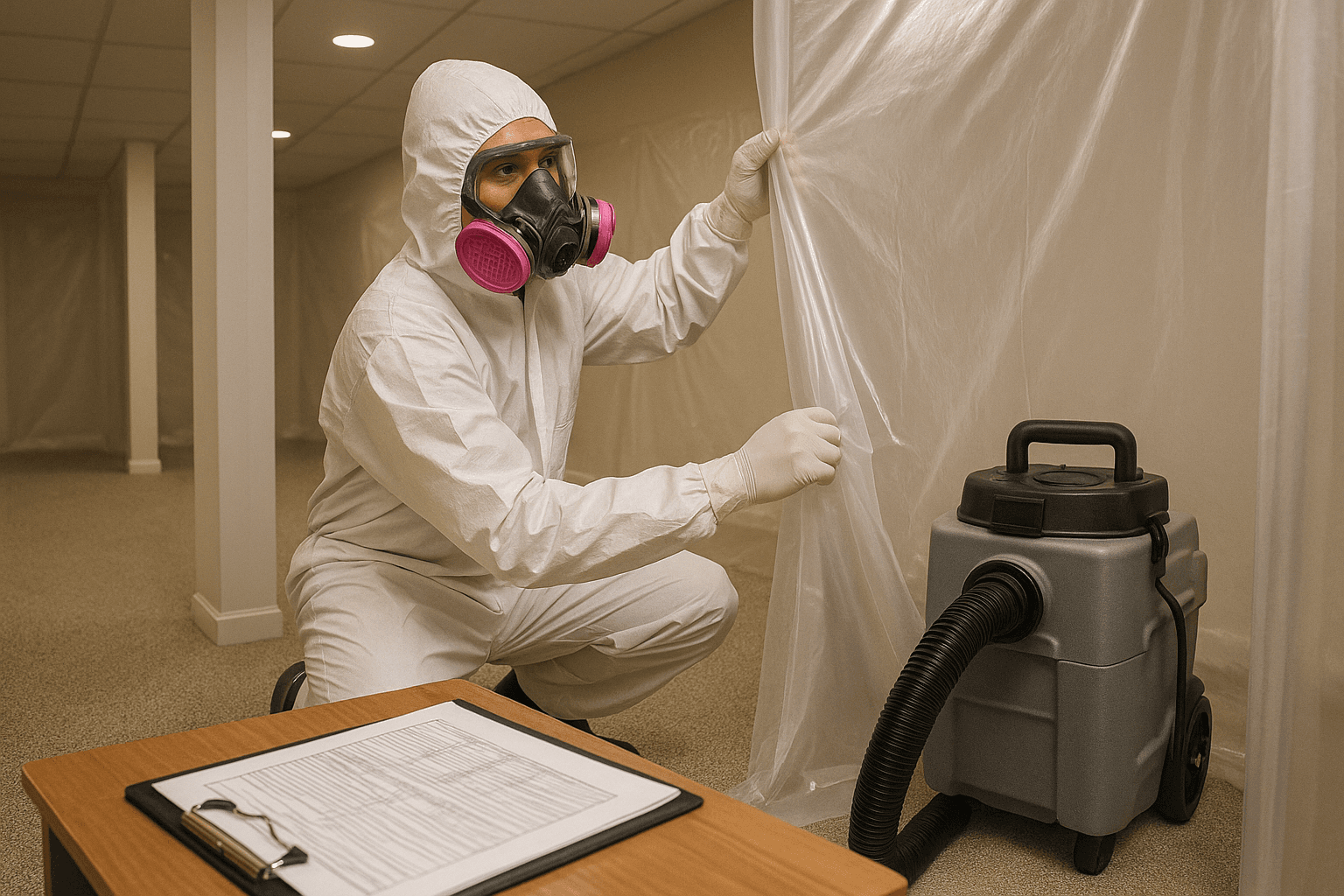
The remediator seals the affected area with poly sheeting barriers and establishes negative air pressure using HEPA-filtered air filtration devices. This prevents spores from migrating to unaffected rooms during the work.
3. HEPA vacuuming
All surfaces in the containment zone are HEPA-vacuumed before any demolition begins, capturing loose spores that would otherwise become airborne when materials are disturbed.
4. Demo and removal
Non-salvageable materials — typically drywall, insulation, and carpet backing — are removed, double-bagged in poly, and disposed of as mold-contaminated waste. Structural framing is retained where possible.
5. Antimicrobial treatment
Exposed framing and remaining surfaces are treated with an EPA-registered antimicrobial. On Stachybotrys jobs, HEPA sanding or media blasting of affected wood follows to remove embedded hyphal growth.
6. Structural drying
Industrial dehumidifiers and air movers run until all remaining materials test below 12% moisture content — the threshold at which mold cannot recolonize.
7. Post-remediation verification (PRV)
An independent licensed assessor returns for air sampling and visual clearance. Only when PRV passes is containment removed and the space released for rebuild. This is the step that proves the job worked.
Cost Ranges for Suffolk County in 2026
- Small area under 10 sq ft (bathroom ceiling spot, window sill): $500–$1,500. Below the Article 32 threshold, so an assessor is not legally required — though we still recommend one for anything in a wall cavity.
- Moderate job, 10–100 sq ft (basement wall section, bathroom with hidden cavity, finished room): $1,500–$5,000. Mandatory Article 32 assessment adds $300–$600 to the overall cost.
- Large or structural job (full finished basement, whole-floor water damage, post-flood Category 3 intrusion): $5,000–$15,000+. Includes structural drying, full demo, PRV clearance, and disposal.
DIY vs. Professional: When Each Makes Sense
The EPA's guidance allows homeowners to DIY mold removal on areas under 10 square feet using appropriate PPE (N95 respirator, gloves, goggles) and an EPA-registered cleaner. That guidance is reasonable in limited circumstances — a small bathroom ceiling spot on a fiberglass-faced ceiling tile, for example.
On Long Island, we advise caution with even small visible patches for one reason: Suffolk County moisture problems almost always indicate a larger underlying issue. What looks like a 4-square-foot basement corner patch is frequently the front face of a colony extending 20+ square feet into the wall cavity and subfloor. Without thermal imaging and moisture metering, you cannot see what is behind the surface. DIY on a corner that turns out to be 80 square feet of structural framing mold is not just ineffective — it risks worsening the air quality problem by disturbing a large colony without containment.
What Homeowners Insurance Covers
Standard HO-3 policies cover mold that results from a sudden and accidental covered water event — a burst pipe, supply line failure, or roof damage from a storm. They do not cover mold from long-term humidity, maintenance neglect, or exterior flooding (which requires a separate NFIP flood policy).
Suffolk County's South Shore flood zones create an insurance complexity: post-storm basement flooding often involves NFIP territory, while sump pump failures or backed-up drains during the same event may be HO-3 water backup riders. Documenting the specific source of intrusion — not just "the storm" — is what determines coverage. Insurers approve claims that link mold to a datable water event with moisture-meter readings, photo documentation, and a written assessor's cause-of-loss narrative. They deny claims framed as "we've had mold for a while."
Suffolk County Towns We Serve
We are licensed and active throughout Suffolk County, including Babylon, Huntington, Smithtown, Islip, Brookhaven, and the East End — Riverhead, Southold, Southampton, East Hampton, and Shelter Island. South Shore towns with high basement mold risk (Bay Shore, West Islip, Amityville, Lindenhurst, Islip Terrace) see the heaviest volume of our work. North Shore and East End calls typically involve attic mold tied to salt-air humidity and ventilation deficiencies in older homes.
Emergency response is available 24 hours a day, with on-site arrival within 24–48 hours for active flooding or acute mold situations. Call us or request an estimate online and we will schedule an initial assessment, usually within 48 hours.
Frequently Asked Questions
- How do I know if I have Stachybotrys (true black mold) vs. another mold?
- You cannot tell by color alone. Cladosporium and Aspergillus/Penicillium both appear dark green, brown, or black. True Stachybotrys requires lab identification from an air or surface sample analyzed at an AIHA-accredited lab. A NYLMB-licensed mold assessor can collect the sample. In practice, the remediation protocol for any large visible mold colony is the same regardless of species.
- Is a mold inspection required before removal in Suffolk County?
- Yes, for any job over 10 square feet. NY Labor Law Article 32 requires a written scope from a licensed mold assessor (MA license) before remediation begins. The assessor and remediator must be different entities — the same company cannot both inspect and perform the cleanup on the same property.
- What does a typical black mold removal job cost in Suffolk County?
- In 2026, small jobs under 10 sq ft run $500–$1,500. Moderate jobs (10–100 sq ft) run $1,500–$5,000 including a mandatory assessor's report. Large structural jobs or post-flood Category 3 projects run $5,000–$15,000+. These are fully completed costs including containment, removal, antimicrobial treatment, structural drying, and post-remediation verification.
- Does homeowners insurance cover black mold removal?
- Standard HO-3 policies cover mold caused by sudden and accidental covered events — burst pipes, appliance failures, storm-related roof damage. They exclude mold from long-term humidity, maintenance neglect, or exterior flooding. South Shore Suffolk homes in flood zones typically need an NFIP flood policy for storm surge events. Document the triggering water event with photos and moisture readings — that documentation is what separates an approved claim from a denial.
- How long does black mold removal take in a typical Suffolk County basement?
- A moderate finished-basement job (10–100 sq ft) typically runs 2–3 days: one day for containment and demo, one day for treatment and drying setup, then 48–72 hours for structural drying before post-remediation verification. Large jobs or those involving Category 3 water (sewage or storm surge) take 4–7 days. We provide a written timeline in every scope of work before any job begins.
Need help with your specific situation?
We do free on-site assessments across Long Island.
NYLMB-licensed, IICRC-certified, insurance-experienced. Call (631) 625-8807 or request an estimate online.